 blog
blog
Water Damage Restoration Company: How to Choose
Table of Contents
- What a Water Damage Restoration Company Actually Does
- How to Verify Credentials and Restoration Standards
- Emergency Water Damage Restoration: What to Expect in the First 24 Hours
- Water Damage Restoration Timeline: From Call to Completion
- Water Damage Restoration Cost: What Drives the Price
- Water Damage Insurance Claim: How to Document and Coordinate
- Choosing a Reputable Contractor: Red Flags and Questions to Ask
- Conclusion: Act Fast, Choose Carefully
- Frequently Asked Questions
Last Updated: October 6, 2026
What a Water Damage Restoration Company Actually Does
A water damage restoration company is a licensed contractor that removes standing water, dries structural materials, and returns a property to its pre-loss condition after a leak, flood, or burst pipe.
The job starts with damage assessment: finding every wet surface, including the ones you cannot see. Water travels along joists, wicks up drywall, and pools under flooring long after the visible puddle is gone.
Water categories and why they change the job
Not all water is equal, and the category determines how much material has to be thrown away.
- Category 1 (clean water): burst supply lines, rain intrusion, overflowing sinks. Lowest risk if dried fast.
- Category 2 (gray water): washing machine discharge, toilet overflow without solids, seepage. Carries bacteria and needs sanitizing.
- Category 3 (black water): sewage backups, river flooding, ground-surface water. Treated as contaminated water and requires full protective handling.
Here is the part most people get wrong: water can drop from Category 1 to Category 3 simply by sitting. Within a day or two, clean water picks up contaminants from whatever it touches. That is the real reason emergency response matters more than the size of the puddle.
EPA guidance on indoor water and mold
How to Verify Credentials and Restoration Standards
Ask for proof before you sign anything. A reputable contractor will hand over documentation without hesitation.
- IICRC certification for water damage restoration technicians (look for WRT and ASD credentials)
- State licensing where required for home improvement or mold work
- Liability insurance and workers' compensation certificates
- Written scope of work with moisture readings before and after
The IICRC restoration standards overview sets the drying benchmarks most insurers recognize. If a company cannot explain which standard it follows, that is your answer.
Emergency Water Damage Restoration: What to Expect in the First 24 Hours
The first day decides how much of your property survives. A professional crew typically arrives, stops the source, extracts standing water, and sets drying equipment within hours of your call.
Hour 0-1: Your call and the phone triage
A real emergency line reaches a person, not a voicemail. Expect the dispatcher to ask: the water source (if known), whether it is still running, the approximate square footage affected, whether sewage is involved, and whether anyone has health concerns. Those answers determine what equipment and how many technicians get dispatched. If the source is a Category 3 loss, sewage backup or ground-surface flooding, say so on the call.
Hour 1-4: Arrival, source control, and extraction
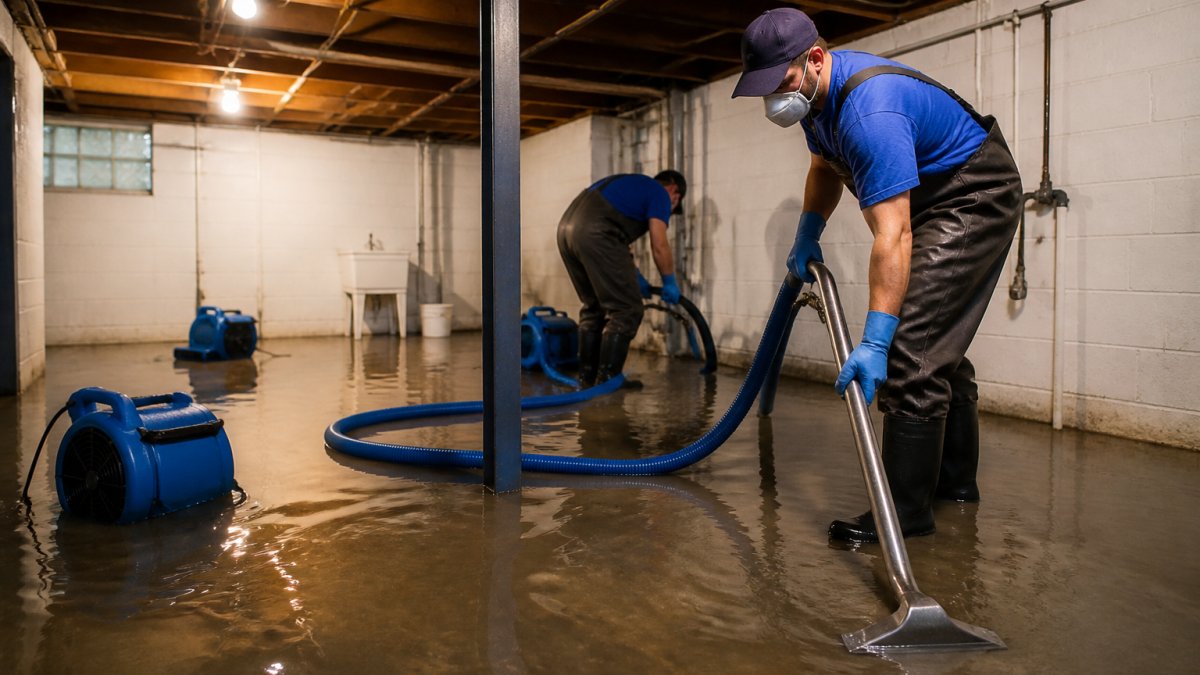
On arrival, the crew should confirm the source is stopped, then walk the space with you to document conditions before anything moves. Extraction comes next, using truck-mounted units for large volumes or portable extractors for tight spaces like closets and under cabinets. Truck-mounted units pull more water faster but need hose access to the street; portable units trade speed for reach.
Hour 4-24: Moisture mapping and equipment placement
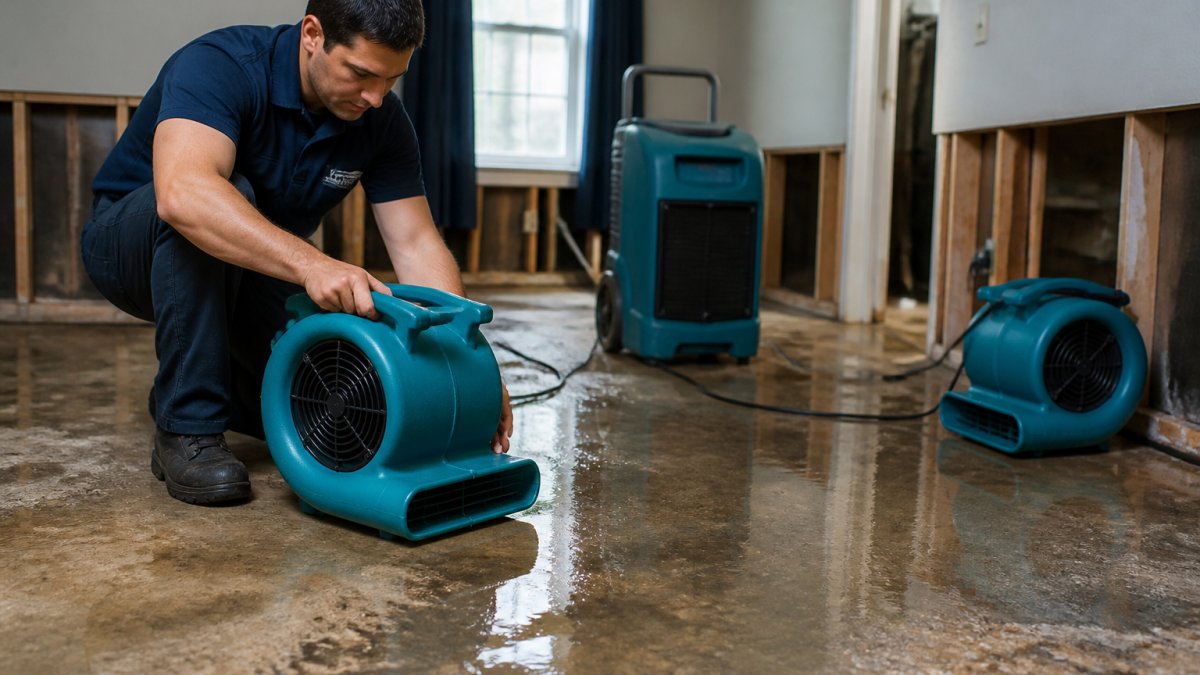
This is the step homeowners underestimate. Technicians use thermal imaging cameras to find temperature differences that reveal hidden saturation, then pin-type or non-penetrating meters to confirm moisture content in drywall, subfloor, and framing. Equipment is then placed on a calculated grid, air movers angled to create a vortex across wet surfaces, dehumidifiers sized to the cubic footage of the affected area.
Steps you can take before help arrives
- Shut off the water supply at the main valve. If you cannot find it, shut off the nearest fixture valve.
- Cut power to affected rooms only if the panel is dry and reachable. Never stand in standing water while touching a panel or outlet.
- Move furniture and valuables off wet flooring. Place aluminum foil or plastic wrap under wood furniture legs to prevent stain transfer.
- Do not run a household vacuum or shop vac on standing water. It is an electrocution risk and can spread contaminated water.
- Do not use a household fan to dry the area. It can push moisture into unaffected rooms and spread mold spores.
- Photograph and video everything before you touch it, including close-ups of the water line on walls and the source of the leak.
EPA guidance on indoor water and mold
Water Damage Restoration Timeline: From Call to Completion
Most residential water damage restoration timelines run three to five days for drying, then longer if reconstruction is needed. The drying phase is not guesswork; it ends when moisture readings match a dry standard, not when the floor feels dry.
| Phase | Typical Duration | What Happens |
|---|---|---|
| Emergency response | Same day | Source stopped, extraction begins |
| Water removal | 1 day | Standing water extracted |
| Drying and dehumidification | 3-5 days | Air movers and dehumidifiers run continuously |
| Cleaning and sanitizing | 1-2 days | Contaminated surfaces treated |
| Repair and reconstruction | Days to weeks | Drywall, flooring, subfloor, paint |
Hidden damage is the wildcard. Water that reached the subfloor or joists can extend drying by days and turn a small repair into a full flooring replacement.
Water Damage Restoration Cost: What Drives the Price
Pricing depends on water category, square footage, materials affected, and how long drying takes. No two losses are identical, so any company quoting a firm number over the phone without seeing the space is guessing. But "it depends" is not a useful answer when you are trying to decide whether to authorize work. Here is how the numbers actually get built.
The cost drivers, in order of impact
- Category of water. A clean supply-line leak is the cheapest scope. Category 2 (gray water) adds sanitizing and disposal. Category 3 (sewage or ground-surface flooding) adds containment, PPE, and regulated disposal, which is why it is the most expensive per square foot.
- Square footage and affected materials. Carpet and pad are often removed and replaced. Hardwood, laminate, and subfloor frequently do not survive and must be torn out. The more porous material in the path, the higher the bill.
- Access and complexity. A finished basement with built-in cabinetry, tile, or a dropped ceiling takes longer to dry and longer to reconstruct than an open room. Crawlspaces and second-floor losses add labor.
- Drying duration. Equipment runs until moisture readings match a dry standard. A loss that dries in three days costs less in equipment time than one that takes six.
- Mold remediation. If mold is already present, that is a separate scope with its own containment, negative air pressure, and clearance testing, and it is usually billed separately from the water work.
- Reconstruction. Mitigation (extraction, drying, cleaning) and reconstruction (drywall, flooring, paint) are often two different line items, sometimes two different companies. Ask which one you are being quoted for.
What a typical estimate breaks into
A useful estimate is itemized, not a lump sum. Look for separate lines for:
- Emergency response and after-hours labor
- Water extraction (equipment and labor)
- Drying equipment (air movers and dehumidifiers, usually billed per unit per day)
- Monitoring visits and moisture documentation
- Cleaning, sanitizing, and deodorizing
- Debris removal and disposal
- Reconstruction materials and labor
A single number makes it impossible to compare bids or challenge an insurer's payout. If a contractor will not itemize, that is a red flag.
Questions to ask before you authorize work
- Is the estimate for mitigation only, or does it include reconstruction?
- How are drying equipment days billed, and who decides when drying ends?
- Is there a separate charge for after-hours or weekend response?
- Will you bill my insurer directly, or do I pay and get reimbursed?
- What happens if the scope changes mid-job, how is that approved?
How insurance changes what you actually pay
Most standard homeowner policies cover sudden and accidental water damage, subject to your deductible. That means your out-of-pocket cost is often the deductible plus any work that exceeds your coverage limit or falls outside the policy, long-term seepage and neglect are common exclusions.
For a current estimate on your property, get a quote from TWO BROTHERS RESTORATION and they will walk the space with you and provide an itemized scope.
Water Damage Insurance Claim: How to Document and Coordinate
Your insurance claim lives or dies on documentation. Most standard homeowner policies cover sudden and accidental water damage, but they exclude long-term seepage and neglect.
Build your file before the adjuster arrives:
- Photos and video of every affected room, taken before cleanup
- A written inventory of damaged belongings with approximate age and value
- Moisture readings and a daily drying log from your contractor
- All receipts for emergency repairs or temporary lodging
A restoration company that coordinates directly with your insurer saves you from becoming the middleman. They document to carrier standards, which reduces back-and-forth and speeds approval.
Choosing a Reputable Contractor: Red Flags and Questions to Ask
The wrong contractor turns a manageable loss into a months-long fight. Use these questions before you commit.
- Are you licensed and insured, and can I see the certificates?
- Who is your point of contact for my insurance claim?
- Will you provide daily moisture readings?
- Do you handle reconstruction in-house or subcontract it?
- What is your response time guarantee in writing?
Red flags: cash-only demands, pressure to sign before you have an estimate, no physical business address, and crews that arrive without marked vehicles or identification.
Conclusion: Act Fast, Choose Carefully
Water damage will not wait for a convenient moment, and every hour of delay adds to the repair bill and the risk of mold.
TWO BROTHERS RESTORATION provides 24/7 emergency disaster restoration with trained technicians, direct insurance coordination, and full-service water, fire, smoke, mold, and biohazard mitigation. Get a quote today and let them restore your property to its pre-damage condition.
Frequently Asked Questions
How much does it usually cost to fix water damage?
Water damage restoration cost depends on the water category, the size of the affected area, materials involved (drywall, flooring, subfloor), and whether mold remediation is needed. Because every job is different, reputable companies provide a detailed, itemized estimate after an on-site assessment. Two Brothers Restoration offers free quotes for properties in NYC, Long Island, Staten Island, Nassau, and Suffolk County, so you can understand the scope before work begins.
How quickly should I call a water damage restoration company?
Call immediately. Mold can begin growing within 24 to 48 hours of water exposure, and structural materials like drywall and subfloor can weaken fast. Emergency water damage restoration services are available 24/7, and a fast response reduces the total damage and the final cost. If you are in the NYC metro area, contact Two Brothers Restoration for same-day service and immediate support.
Does homeowners insurance cover water damage restoration?
Most homeowners insurance policies cover sudden and accidental water damage, such as a burst pipe or appliance failure, but they typically exclude gradual leaks and flooding from outside. A water damage insurance claim requires thorough documentation: photos, moisture readings, and a detailed estimate. Two Brothers Restoration coordinates directly with your insurance company and provides the documentation needed to support your claim.
What should I ask before hiring a water damage restoration company?
Ask about certifications (IICRC, OSHA), 24/7 availability, response time, insurance coordination, and whether they provide a written, itemized estimate. Also ask for proof of licensing and liability insurance. A reputable contractor will answer these questions clearly and provide references. Two Brothers Restoration is happy to share credentials and walk you through the process before you commit.